

Are you wondering if the dumbbell bench press is harder than other chest exercises? You’re not alone.
Many people find themselves asking this question when trying to build strength and muscle effectively. Understanding the challenges and benefits of the dumbbell bench press can make a big difference in your workout results. Keep reading to discover what makes this exercise unique, how it impacts your muscles, and whether it’s the right move for your fitness goals.
This knowledge could change the way you train forever.
Dumbbell Vs Barbell Bench Press
The dumbbell bench press and barbell bench press are popular exercises for building chest muscles. Each offers unique challenges and benefits.
Understanding their differences can help choose the right one for your workout goals. Let’s explore how they differ in movement path, range of motion, and muscle activation.
Differences In Movement Path
The movement path in a dumbbell bench press is more flexible. Each arm moves independently, allowing for a natural arc.
In contrast, the barbell bench press has a fixed path. Both arms push the bar in a straight line together.
- Dumbbells allow more control and adjustability
- Barbells provide stability and ease of control
Range Of Motion Variations
Dumbbell bench presses offer a greater range of motion. The arms can go lower, stretching the chest muscles more.
Barbells limit the range, stopping when the bar touches the chest. This can restrict muscle stretch.
- Dumbbells enhance flexibility and muscle stretch
- Barbells provide consistent range limitation
Muscle Activation Patterns
Using dumbbells requires stabilizing muscles to work harder. This activates more muscle fibers in the chest, shoulders, and arms.
Barbells focus more on the pectoral muscles. They require less from the stabilizing muscles due to the fixed grip.
- Dumbbells engage more stabilizing muscles
- Barbells target the chest muscles directly
Stability And Control Factors
The dumbbell bench press is different from the barbell version. It requires more stability and control during the lift. This makes it feel harder for many people.
Understanding how stability and control affect this exercise helps improve performance and safety. Small muscles work harder to keep balance and guide the weights.
Role Of Stabilizer Muscles
Stabilizer muscles keep your body steady during the dumbbell bench press. They work to prevent the weights from moving in unwanted ways. These muscles include the rotator cuff, triceps, and muscles around the shoulder blades.
Since each arm moves independently, stabilizers work more than with a barbell. This added effort makes the dumbbell bench press harder for your muscles and control.
- Rotator cuff muscles stabilize the shoulder joint
- Triceps assist in locking out the elbows
- Scapular muscles keep your shoulder blades steady
Balance Challenges
Balancing two dumbbells is harder than lifting one barbell. Each arm must control its own weight. This creates a challenge to keep the weights moving evenly and smoothly.
If your balance is off, the dumbbells may move unevenly. This can cause poor form and reduce the effectiveness of the exercise. Good balance helps target the chest muscles better.
- Each arm works independently
- More focus needed to keep dumbbells steady
- Balance mistakes can lead to uneven muscle work
Impact On Shoulder Health
The dumbbell bench press can be better for shoulder health if done right. The free range of motion allows shoulders to move naturally. This reduces stress on the joints compared to a fixed bar path.
Stabilizer muscles also help protect the shoulder joint by keeping it stable. But poor control or too heavy weights can cause strain or injury. Proper form and weight choice matter for shoulder safety.
- Natural arm movement reduces joint stress
- Stronger stabilizers protect shoulder joints
- Improper form may cause shoulder pain
Strength And Muscle Development
The dumbbell bench press is a popular exercise for building upper body strength. It targets the chest, shoulders, and triceps. Many ask if it is harder than the barbell bench press.
This article looks at how dumbbell bench press affects strength and muscle growth. We compare load capacity, muscle growth potential, and progression.
Load Capacity Comparison
The dumbbell bench press usually handles less weight than the barbell version. This is because each arm works independently, requiring more control.
Barbells allow you to lift heavier loads because both arms work together. This helps with maximum strength gains.
- Dumbbells need more balance and stability.
- Barbells allow heavier lifting with more support.
- Load limits differ due to equipment and technique.
Muscle Growth Potential
Dumbbells offer a greater range of motion than barbells. This can lead to better muscle activation and growth.
Using dumbbells also helps reduce muscle imbalances. Each side must work equally, which improves overall muscle development.
- Greater range of motion with dumbbells.
- Improves muscle balance and coordination.
- Barbells allow heavier loads, aiding muscle size.
Progression And Plateau
Progress with dumbbells can be slower due to limited weight increments. This may cause plateaus sooner than barbells.
Barbells allow easier progression by adding small weight plates. This helps continue strength and muscle gains over time.
- Dumbbells have fixed weight steps.
- Barbells allow smaller, adjustable weight increases.
- Plateaus may come faster with dumbbells.

Credit: powerblock.com
Technique And Form Challenges
The dumbbell bench press is a popular chest exercise. It demands good technique and form to avoid injury. This move can be harder than the barbell version. This is because you need to control each dumbbell separately.
Many lifters find the dumbbell bench press tricky. It challenges your grip, wrist, and body balance. Focusing on proper technique helps you get the best results safely.
Grip And Wrist Positioning
Holding dumbbells needs more wrist control than a barbell. You must keep your wrists stable to avoid strain. Your grip should be firm but not too tight.
Wrist position affects how the weight moves. Keep your wrists straight and aligned with your forearms. Avoid bending them backward or forward during the press.
- Hold dumbbells with a neutral grip (palms facing each other)
- Keep wrists firm and straight
- Avoid wrist bending during the lift
- Use controlled motion to reduce strain
Range Of Motion Control
Dumbbells allow a wider range of motion than barbells. This means your muscles work harder. You must lower the weights carefully to avoid shoulder injury.
Control the dumbbells on the way down and up. Do not drop them quickly or bounce at the bottom. Keep the movement smooth and steady to protect your joints.
- Lower dumbbells until your elbows are just below bench level
- Pause briefly at the bottom for muscle activation
- Press up with steady, controlled force
- Avoid locking elbows at the top
Breathing And Core Engagement
Breathing helps keep your body stable during the press. Inhale as you lower the dumbbells. Exhale as you push them up.
Your core must stay tight to support your back. Engage your abdominal muscles to keep balance and prevent arching. This helps transfer power safely through your body.
- Inhale deeply before lowering dumbbells
- Exhale while pressing up
- Tighten your core muscles throughout the lift
- Keep your lower back pressed gently into the bench
Benefits Of Dumbbell Bench Press
The dumbbell bench press is a common exercise for chest strength. It uses dumbbells instead of a barbell. This change brings many benefits to your workout.
Using dumbbells lets you move more naturally and helps balance muscles. It also offers different ways to train your upper body.
Improved Muscle Symmetry
Dumbbells require each arm to work on its own. This helps fix strength differences between sides. Both arms get equal work, which improves muscle balance.
Better muscle symmetry reduces injury risk and makes your chest look more even. It also helps your body move better in daily activities.
Joint-friendly Movement
Dumbbells allow your wrists and shoulders to move freely. This reduces strain on your joints. You can find a comfortable range of motion that suits your body.
This joint-friendly movement lowers the chance of pain or injury. It is helpful for people with shoulder issues or limited mobility.
Versatility In Training
You can adjust dumbbell angles and positions easily. This lets you target different parts of your chest and arms. You can do flat, incline, or decline presses with dumbbells.
- Change grip to work different muscles
- Use light or heavy weights for variety
- Combine with other exercises for full workouts

Credit: www.yahoo.com
Common Mistakes And Solutions
The dumbbell bench press is a great exercise, but it can be harder than the barbell version. Many people make mistakes that cause problems. Knowing these mistakes helps you fix them and get better results.
Below are common mistakes and ways to avoid them. These tips focus on balance, fatigue, and safety during the exercise.
Avoiding Imbalance
Using dumbbells can cause muscle imbalances if one arm works harder. This happens when you lift unevenly or favor your stronger side. It can lead to injury or slow progress.
To avoid imbalance, focus on moving both dumbbells at the same speed. Use lighter weights if needed to keep control. Practice good form and watch yourself in a mirror.
- Start with lighter dumbbells to build control
- Move both arms evenly and avoid rushing
- Check your form in a mirror or with a trainer
- Use dumbbells of equal weight on both sides
Managing Fatigue
The dumbbell bench press uses more stabilizer muscles than a barbell. These muscles get tired faster, which can affect your form and strength. Fatigue raises the risk of injury.
To manage fatigue, take longer rest breaks between sets. Lower the weight if your form starts to slip. Focus on slow, controlled movements to keep muscles working safely.
- Rest for 1-2 minutes between sets
- Reduce weight if control gets worse
- Keep movements slow and steady
- Stop if you feel sharp pain or extreme tiredness
Ensuring Proper Spotting
Spotting is important for safety with dumbbell bench presses. Dumbbells can move in many directions, so a spotter helps prevent accidents. Without a spotter, you might drop the weights or strain muscles.
If you do not have a spotter, use lighter weights and avoid pushing to failure. You can also use a power rack or bench with safety arms. Always prepare to safely lower the dumbbells if needed.
- Have a trained spotter when lifting heavy
- Use safety racks if no spotter is available
- Lower weights slowly and with control
- Never lift dumbbells that are too heavy without help
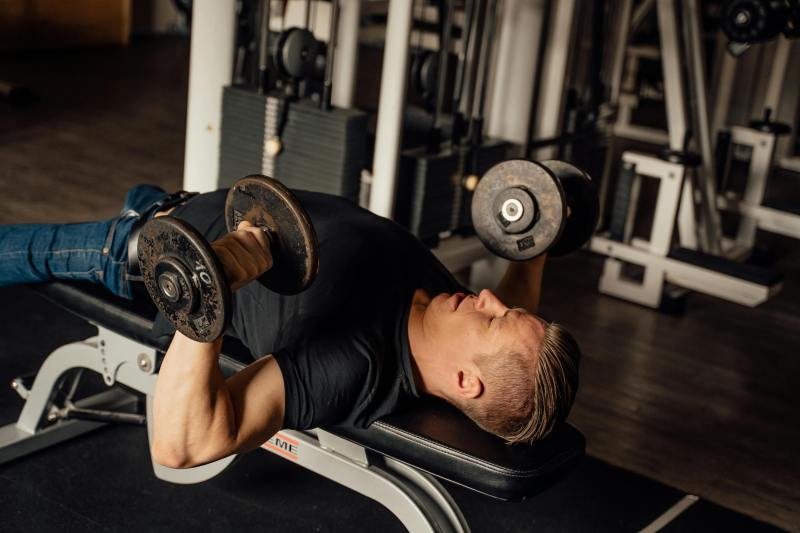
Credit: www.themanual.com
Frequently Asked Questions
Is Dumbbell Bench Press Harder Than Barbell Bench Press?
Dumbbell bench press requires more stabilization, making it harder for many. It engages smaller muscles, improving balance and coordination. Barbell allows heavier loads, but dumbbells enhance muscle activation and control.
Why Does Dumbbell Bench Press Feel More Challenging?
Dumbbells demand greater balance and coordination. Each arm moves independently, increasing muscle activation. This leads to improved joint stability and a higher difficulty level compared to barbell presses.
Does Dumbbell Bench Press Improve Muscle Symmetry?
Yes, dumbbells correct muscle imbalances by forcing equal effort from both arms. This promotes balanced muscle growth and reduces injury risk caused by dominant side compensation.
Can Dumbbell Bench Press Increase Shoulder Stability?
Absolutely. Dumbbell presses require shoulder stabilizers to work harder. This builds joint strength, improves range of motion, and helps prevent common shoulder injuries.
Conclusion
Dumbbell bench press challenges your muscles differently than barbells. It demands more control and balance from you. This can make the exercise feel harder for many people. Yet, it also helps improve muscle symmetry and joint stability. Choosing between dumbbells and barbells depends on your goals and comfort.
Both have unique benefits worth exploring. Try both to see which fits your strength journey best. Keep pushing, and your chest will grow stronger over time.


