

Have you ever noticed that the dumbbell bench press feels way tougher than the barbell version? You’re not imagining things.
There’s a real reason why using dumbbells challenges your muscles and balance differently. If you want to understand why your workout feels harder and how this can actually help you get stronger, keep reading. This insight will change the way you approach your chest day and boost your results.
Let’s dive into what makes the dumbbell bench press a step above the barbell.

Credit: www.menshealth.com
Dumbbell Vs Barbell Mechanics
Dumbbells and barbells are popular for strength training. They both work muscles but have different mechanics.
Understanding their mechanics helps in choosing the right tool for your workout. Let’s explore why dumbbells feel harder than barbells.
Range Of Motion Differences
Dumbbells allow a wider range of motion. Each arm moves independently, which can engage more muscles.
Barbells restrict movement because both arms work together. This limits the range but provides more stability.
- Dumbbells: Wider range, more muscle engagement
- Barbells: Limited range, more stability
Stability And Balance Challenges
Using dumbbells requires more balance. Each arm must stabilize the weight, which can be challenging.
Barbells provide more balance because the weight is evenly distributed. This makes them easier to control.
- Dumbbells: Higher balance challenge, harder to control
- Barbells: Lower balance challenge, easier to control

Credit: www.fitsyology.com
Muscle Activation Variations
Dumbbell bench presses activate muscles differently than barbell presses. This difference affects how your muscles work during the exercise.
Understanding these muscle activation changes helps explain why dumbbell bench presses feel harder for many people.
Increased Stabilizer Muscle Engagement
Dumbbells require you to control each arm separately. This need increases the work of stabilizer muscles around your shoulders and chest.
Stabilizer muscles keep your arms steady and balanced. They work harder with dumbbells than with a barbell, which holds the weight fixed.
- Shoulder stabilizers help control arm movement
- Chest muscles balance the load on each side
- Core muscles support overall body stability
Impact On Muscle Symmetry
Dumbbell presses force each side of the body to work independently. This action helps fix strength imbalances between your left and right muscles.
Barbells can let the stronger side take over. Dumbbells make both sides do equal work, improving muscle symmetry over time.
- Each arm lifts its own weight
- Prevents dominance of one side
- Promotes even muscle growth
Strength Requirements
Dumbbell bench press is harder than barbell bench press because it needs more strength. Each arm works alone, so muscles must be strong on both sides.
The weight feels heavier since you cannot balance it with your other arm. This increases the effort your muscles must give to lift the dumbbells.
Unilateral Load Demands
Dumbbell bench press forces each arm to lift its own weight. This is called unilateral loading.
This demand helps fix strength differences between arms. It also makes muscles work harder to stabilize the weight alone.
- Each arm lifts independently
- Muscles stabilize the dumbbell
- Strength imbalances become clear
Coordination And Control Factors
Using dumbbells requires more coordination than a barbell. You must control each dumbbell’s path and balance.
This control makes the exercise harder because your body works to keep the weights steady and aligned.
- Each hand moves separately
- Your body balances the weights
- Muscles work to keep control
Common Struggles With Dumbbells
Dumbbell bench press feels harder than barbell for many people. This happens because dumbbells need more control and balance.
Using dumbbells requires more effort from small muscles. These muscles help keep the weights steady during the lift.
Fatigue And Grip Strength
Dumbbells make your hands and forearms work harder. Holding each weight separately tires your grip faster than a barbell.
When your grip gets weak, it is harder to lift the dumbbells safely. This can limit how much weight you can use.
- Each hand must hold the full weight alone
- Wrist muscles work more to keep balance
- Grip strength often limits workout time
Overcoming The Learning Curve
Dumbbell bench press requires more practice than barbell. You need to learn how to control each dumbbell smoothly.
Start with lighter weights to build balance and confidence. This helps you avoid injury and improve quickly.
- Focus on slow and controlled movements
- Use lighter weights to practice form
- Gradually increase weight as you improve
Training Benefits Of Dumbbells
Dumbbell exercises challenge your muscles more than barbells. They need more control and stability.
This makes dumbbell workouts harder but helps improve strength and coordination.
Improved Joint Health
Dumbbells allow a natural movement path for your joints. They reduce strain by letting your wrists and elbows move freely.
This lowers the risk of joint pain and injury compared to fixed barbell positions.
- Less stress on wrists and shoulders
- Encourages safer lifting angles
- Supports joint mobility and flexibility
Enhanced Muscle Balance
Using dumbbells forces both sides of your body to work equally. This helps fix muscle imbalances.
Each arm lifts independently, so the stronger side cannot compensate for the weaker one.
- Builds equal strength on both sides
- Improves coordination between muscles
- Reduces risk of injury from muscle imbalances
Tips To Master Dumbbell Bench Press
Dumbbell bench press can feel harder than barbell press. This is because each arm works on its own. It needs more balance and control.
Using good strategies helps you get stronger and safer with dumbbells. Focus on steady progress and proper form for best results.
Progressive Loading Strategies
Increase the weight gradually to build strength without injury. Start with lighter dumbbells and add small weights over time.
Track your progress and aim to lift a bit more each week. This helps your muscles adapt and grow stronger.
- Begin with a comfortable weight
- Add 2.5 to 5 pounds weekly
- Do more reps before increasing weight
- Use slow, controlled movements
Form And Technique Focus
Keep your back flat and feet planted on the floor. Hold dumbbells with a firm grip and control the movement.
Lower the dumbbells slowly to your chest. Press them up without locking your elbows at the top.
- Keep wrists straight and stable
- Use a full range of motion
- Engage your core for balance
- Breathe out while pushing up
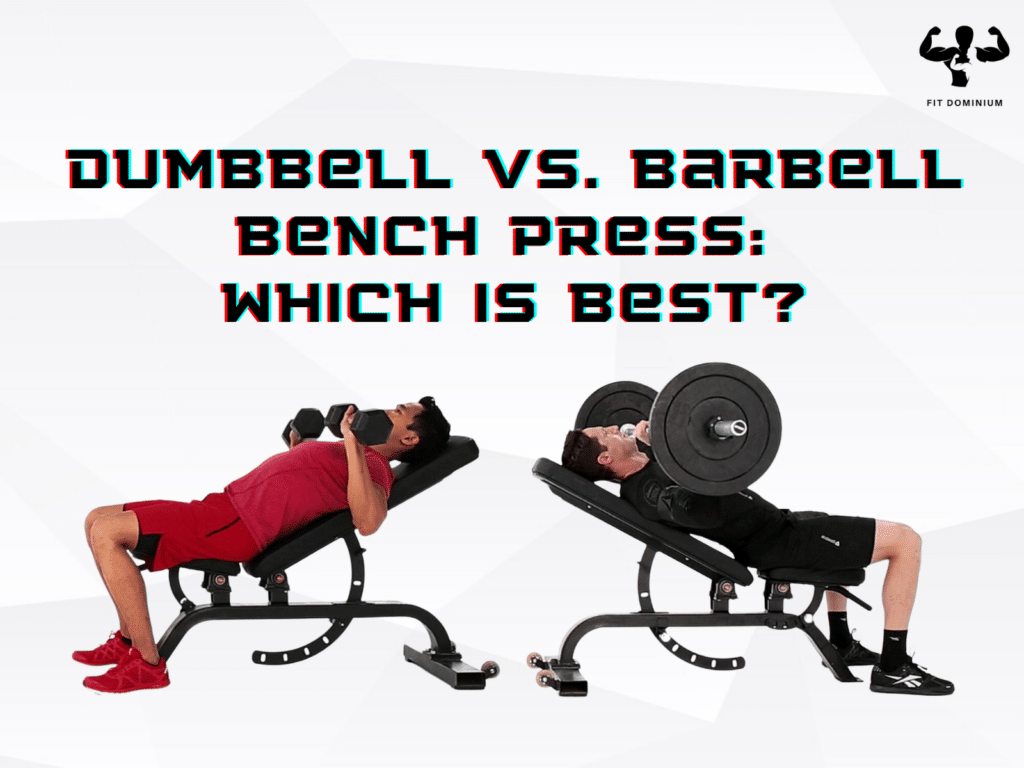
Credit: fitdominium.com
Frequently Asked Questions
Why Is Dumbbell Bench Press Harder Than Barbell?
Dumbbell bench press requires more stability and balance. Each arm works independently, engaging more muscles. Barbell provides a fixed path, making it easier to lift heavier weights.
Does Dumbbell Bench Press Improve Muscle Balance?
Yes, dumbbell bench press helps correct muscle imbalances. Each arm works separately, promoting equal strength development. This reduces the risk of injury and improves overall muscle symmetry.
Which Exercise Builds More Strength, Dumbbells Or Barbell?
Barbell bench press typically allows heavier lifting, building maximal strength. Dumbbells enhance stabilizer muscles and control. Combining both offers balanced strength and muscle growth.
How Does Stabilization Affect Dumbbell Bench Difficulty?
Stabilization increases dumbbell bench difficulty by engaging core and shoulder muscles. You must control each dumbbell’s movement independently. This demands greater neuromuscular coordination than barbell presses.
Conclusion
Dumbbell bench feels harder because it needs more balance and control. Each arm works alone, making muscles work harder. It helps fix strength differences between sides. You also use smaller muscles to keep the dumbbells steady. Barbell bench feels easier since the bar guides the movement.
Both lifts have value for strength and muscle growth. Choose dumbbells to challenge yourself and build stability. Keep practicing to improve your technique and strength. The effort you put in will pay off.


